
Building A (New) Doll's House: An Interview with Justin Emeka
An interview between A Doll’s House Director and Adaptor Justin Emeka and Two River Theater Literary Manager Fiona Kyle.
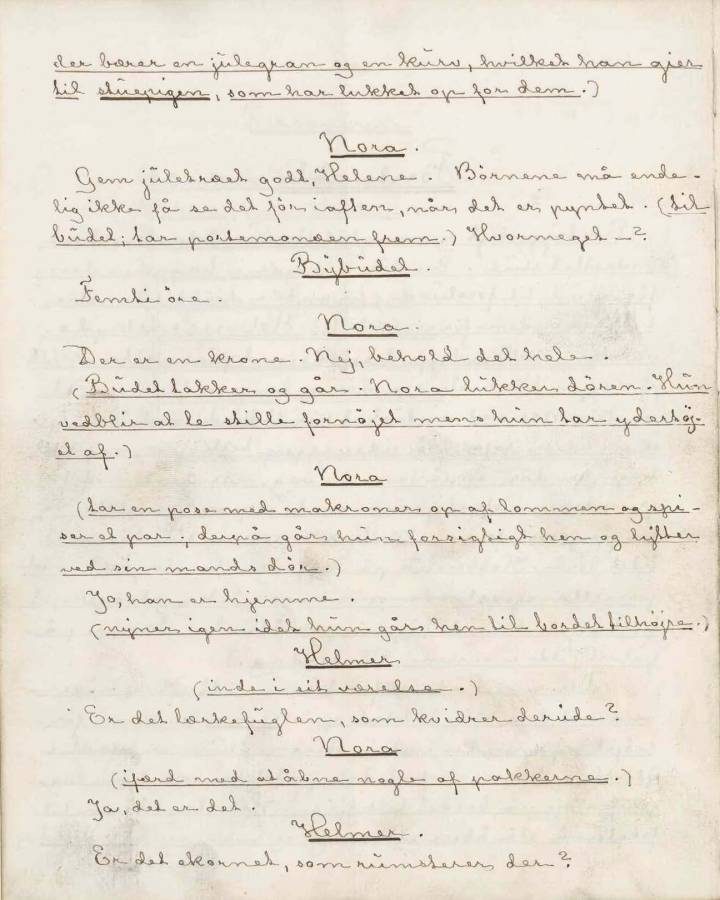
An excerpt from Henrik Ibsen’s A DOLL'S HOUSE in Norwegian, circa 1879 (Library of Congress)
Fiona Kyle: Can you share with us why you were interested in adapting A Doll’s House by Henrik Ibsen? What was your first experience with the original play?
Justin Emeka: Like many theater artists, I was first introduced to A Doll’s House as an acting student in college, doing scene work. Even then, what struck me wasn’t its reputation or its history, but how deeply relatable and human the struggles felt. The play lives inside small moments—conversations, compromises, silences—and I was immediately drawn to how much emotional pressure Ibsen packed into an ordinary household. I remember thinking, even at that early stage, that the play felt ripe for cultural re-imagining, long before I had the language or tools to do that kind of work myself.
Years later, during the pandemic, I was invited to direct A Doll’s House, Part 2 by Lucas Hnath at Juilliard. That experience brought me back into Ibsen’s world from a very different vantage point. For that production, I reimagined Torvald as Afro-Norwegian, drawing on the long but often unseen African presence in Norway. That process clarified something for me: Ibsen’s work doesn’t resist re-contextualization—it invites it. Returning to the original play now feels like a natural continuation of a conversation I’ve been having with this text for most of my artistic life.
Ibsen fundamentally reshaped our understanding of what theater could examine. He insisted that the domestic sphere—marriage, family, financial dependence, reputation—was worthy of serious dramatic attention. In doing so, he helped usher in modern realism and psychological drama. Ibsen understood that human beings are rarely consistent, and that drama emerges from that instability. His plays don’t tell us what to think; they ask us to sit with discomfort and complexity, which is something theater is still grappling with today.

Cara Ricketts (left) as Nora Helmer and Joshua Echebiri (right) as Torvald Helmer in rehearsal.
FK: In your adaptation, Torvald is an immigrant from Guyana, and Nora is a biracial woman. Can you discuss how you chose these two distinct identities and how they inform your production? What else inspired your retelling of Ibsen’s classic?
JE: As a storyteller, my work is always informed by my own history, passions, and lived experience. I was born in New Jersey in 1972, and I have very fond memories of growing up just across the George Washington Bridge in a largely Black and Brown suburban community filled with people from all over the world. That sense of proximity—between cultures, histories, and aspirations—has stayed with me.
I’m also biracial, and I often find myself drawn to stories that explore the intersections of Black and white cultural experience in America: how inheritance, belonging, and respectability operate differently depending on who you are and where you stand. Setting this Doll’s House in 1950s New Jersey within a Black middle-class household allowed those questions to surface organically.
Torvald and Nora’s identities emerged from both personal intuition and dramaturgical necessity. I wasn’t interested in making symbolic changes—I wanted choices that would actively shape the emotional logic of the play. Making Torvald an immigrant from Guyana was very intentional. Guyana is not a place we often think of when we talk about Caribbean identity, despite its deep cultural, historical, and diasporic connections to the Caribbean world. I’m often drawn to overlooked histories—stories that sit just outside dominant narratives—and Guyana holds a particularly complex legacy shaped by colonialism, migration, and cultural hybridity.
For Torvald, that background sharpens his relationship to ambition and respectability. He is not simply striving; he is protecting what he has built. Respectability becomes a form of armor, something that guards against erasure, precarity, and the fear of being seen as disposable. His investment in status, order, and reputation grows out of that history, making his control of the household emotionally legible, even when it becomes harmful.
Nora’s identity as a biracial woman intersects with those pressures differently. She inherits a home and a degree of social stability through her white father, yet she lives inside a Black marriage and a Black community shaped by its own expectations and constraints. She exists at the crossroads of belonging and distance—never fully inside any single narrative. That positioning deepens her adaptability, secrecy, and emotional intelligence, long before those qualities are judged as moral failures.
Together, these identities intensify the central conflict of the play. Their marriage becomes a negotiation between histories, aspirations, and survival strategies that don’t always align. When Nora begins to awaken to the cost of that negotiation, her decision carries expanded stakes. Leaving is no longer just about marriage—it’s about authorship: who gets to define her life, her worth, and her future.
In this way, these identities don’t replace Ibsen’s questions—they sharpen them, allowing the play to speak to American experiences of race, migration, inheritance, and belonging, while remaining deeply faithful to the emotional truth at the heart of A Doll’s House.
The structure and emotional spine of Ibsen’s play remain intact. What shifts is the lens. By centering Nora as a biracial Black woman and Torvald as an Afro-Caribbean immigrant, the stakes of secrecy, aspiration, and autonomy take on a distinctly American resonance—one deeply informed by my own memories and sense of place.
FK: You’re both the adaptor and director for this production of A Doll’s House. Can you share with us how you balance those two roles and how the one may inform the other?
JE: At the core of both roles is my profound love of storytelling. As an adaptor, I see myself as a steward of the written word—listening carefully to what the text is saying, what it’s asking, and what it might reveal in a new context. As a director, I’m guiding the physical, emotional, and spatial expression of that text in the room. The balance comes from allowing those two impulses to inform each other rather than compete. The adaptation must remain flexible enough to respond to actors, designers, and rehearsal discoveries, while direction gives the language weight, rhythm, and embodiment. Ideally, each role sharpens the other.

Caylen Bryant, composer of Original Music for A Doll's House
FK: We will have a live cello being played by Caylen Bryant on stage, who composed the music and is also playing Helen, Torvald Helmer’s sister. Can you talk about the use of music in this production?
JE: One of the great things about being a professor at Oberlin College, is I often get to meet extraordinary students as they begin their artistic journey. I first met Caylen Bryant in her first year at Oberlin College, and I was immediately struck by the depth and soulfulness of her musicianship. She has a very distinctive voice on both cello and upright bass—one that feels deeply grounded and emotionally articulate. We collaborated on several MainStage productions while she was a student, including The Glass Menagerie and The Bluest Eye. When I began imagining the character of Helen in this adaptation, Caylen was already in my mind as I wrote the role—though she didn’t know it at the time.
FK: What do you think A Doll’s House can illuminate for us in 2026?
JE: I think the renewed interest in Ibsen we’re seeing across theaters this season says something important about who we are right now. In moments of cultural uncertainty, artists and audiences often return to writers who ask fundamental questions about truth, responsibility, and self-determination.
In 2026, A Doll’s House reminds us that liberation often begins quietly—with the recognition that a life built for you may no longer fit who you’ve become. The play asks us to examine the bargains we make for safety, respectability, and belonging, and whether those bargains are sustainable.
That ongoing relevance speaks not only to Ibsen’s legacy, but to our present moment. The fact that we’re still drawn to his work suggests that we are still wrestling with many of the same questions—and still looking to theater to help us face them honestly.